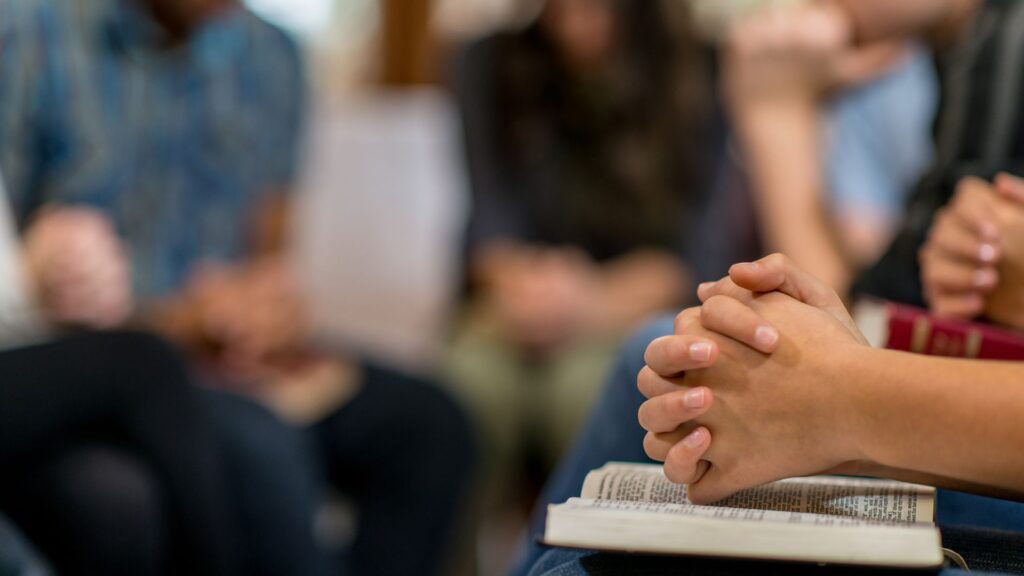
God desires to gather His people together within the framework of biblical teachings, in which Jesus Christ is the central Figure. He is the sole Atoner for our sins and the gateway to fellowship with God (John 10:9). The purpose is to gather in order to strengthen the life of faith and to build up the congregation (Eph. 4:11–16). Some believe that Christians can only gather together in a house of prayer built specifically for that purpose—for example, a church building.
However, the concept of a ”church building” did not exist during the time of the early congregation. The congregation—ekklesia—was a community of those who believed in Jesus. The Bible teaches that, in the early stages of the ekklesia, home meetings were the most common form of gathering and the foundation of its activity (Acts 20:20; Rom. 16:3–5; 1 Cor. 16:19; Col. 4:15). They were familiar with the teaching that ”the Most High does not dwell in houses made by human hands” (Acts 7:48). Paul sent greetings to ”our sister Apphia, our fellow soldier Archippus, and the congregation that meets in your home” (Philem. 1:1–2). ”The house of John’s mother” served as one such meeting place (Acts 12:12), as did the upper room (Acts 1:13). In Ephesus, they had access to a school building where those who had strayed into false teachings were guided back to sound doctrine: “But when some hardened their hearts and refused to believe, and spoke evil of this Way before the crowd, Paul withdrew from them, took the disciples with him, and held daily teaching sessions in the school of Tyrannus” (Acts 19:9). In the apostolic age, there were no church buildings, and the synagogues were closed to them (John 9:22). “From early morning until late in the evening, he explained the Scriptures to them—beginning with the Law of Moses and the Prophets—and testified about the kingdom of God, seeking to convince them concerning Jesus” (Acts 28:23). / “Paul lived for two full years in his own rented quarters and welcomed everyone who came to him” (Acts 28:30).
The congregation of God in Jerusalem must have had many locations for home meetings, as there were tens of thousands of believers (Acts 21:20). Furthermore, “Peter traveled throughout the region and also visited the believers…” (Acts 9:32). Yet, they had only one body of elders, to whom they turned whenever disagreements arose (Acts 15:22). It remains a good practice to follow this example—to seek counsel from those who have been believers from the early days (Acts 15:6; 1 John 1:3). “Imitate their faith” (Hebrews 13:7; cf. 1 Corinthians 1:10). The teaching of the Bible and the example of the early congregation form the foundation for our doctrinal orientation: “Those who accepted Peter’s message were baptized, and about three thousand people were added to the number of believers that day. They devoted themselves to the apostles’ teaching and to fellowship, to the breaking of bread and to prayer” (Acts 2:41, 42). Elders and teachers of the Word help believers remain steadfast in this (1 Thessalonians 5:12, 13). This does not require their presence at every home meeting. “Obey your leaders and submit to their authority, for they keep watch over your interests—as men who must give an account. Obey them so that their work will be a joy, not a burden, for that would be of no advantage to you” (Hebrews 13:17; cf. 1 Peter 5). Therefore, God’s people must not be governed by secular associations or the authorities operating behind them.
It is precisely in home meetings that believers gather together and grow in faith. “So then you are no longer strangers and foreigners, but fellow citizens with the saints and members of the household of God, built on the foundation of the apostles and prophets, with Christ Jesus himself as the cornerstone. In him the whole building, joined together, grows into a holy temple in the Lord, in whom you also are being built together for a dwelling place for God through the Spirit.” Eph. 2:19–22. We who have faith are “the temple of the body of Christ,” which He erected in three days to replace the old, visible temple that was thrown down to the ground. John 2:19–22; Matt. 24:2.
“You also, like living stones, are being built up as a spiritual house, a holy priesthood, to offer up spiritual sacrifices acceptable to God through Jesus Christ.” 1 Pet. 2:5. “God has rescued us from the power of darkness and transferred us to the kingdom of his beloved Son, in whom we have redemption, the forgiveness of sins.” Col. 1:13–14. “For you know that you were not redeemed from the empty way of life inherited from your fathers with perishable things, such as silver or gold, but with the precious blood of Christ, as of a lamb without blemish or defect.” 1 Pet. 1:18–19.
Blessings,
Weijo Lindroos